

In this post we look back to 2025 by focusing on one of the main events of the year which saw the participation of members of the IELTA research team, the International Inter-Association Conference on the History of Language Learning and Teaching (ICHoLLT) 2025. The conference took place at the University of Insubria (Como, Italy), between 5 and 7 June 2025, and it was preceded by a pre-conference event on 4 June, devoted to PhD students and early career researchers, who were given the opportunity to illustrate the findings of their work and receive feedback from their senior colleagues. The papers resulting from the conference presentations will be published in one or more specialised journal(s) or in one or more volume(s), following evaluation by the scientific committee and based on double-blind peer review.

ICHoLLT 2025 main theme was “Back to the past to understand the present. Exploring the interplay between socio-cultural and political developments and language education”. The conference aimed to investigate and explain past developments and challenges in language education in order to offer tools to interpret contemporary issues and problems in teaching and learning foreign languages. The conference featured a variety of presentations which examined the way in which socio-cultural and political trends and events have influenced methods and practices in language education over the centuries, focusing on the teaching of English, French, German, Italian, Portuguese, Russian, Spanish, and Swedish in different local contexts. In addition, the also featured presentations pertaining to the history of language learning and teaching which were not directly related with the main theme.
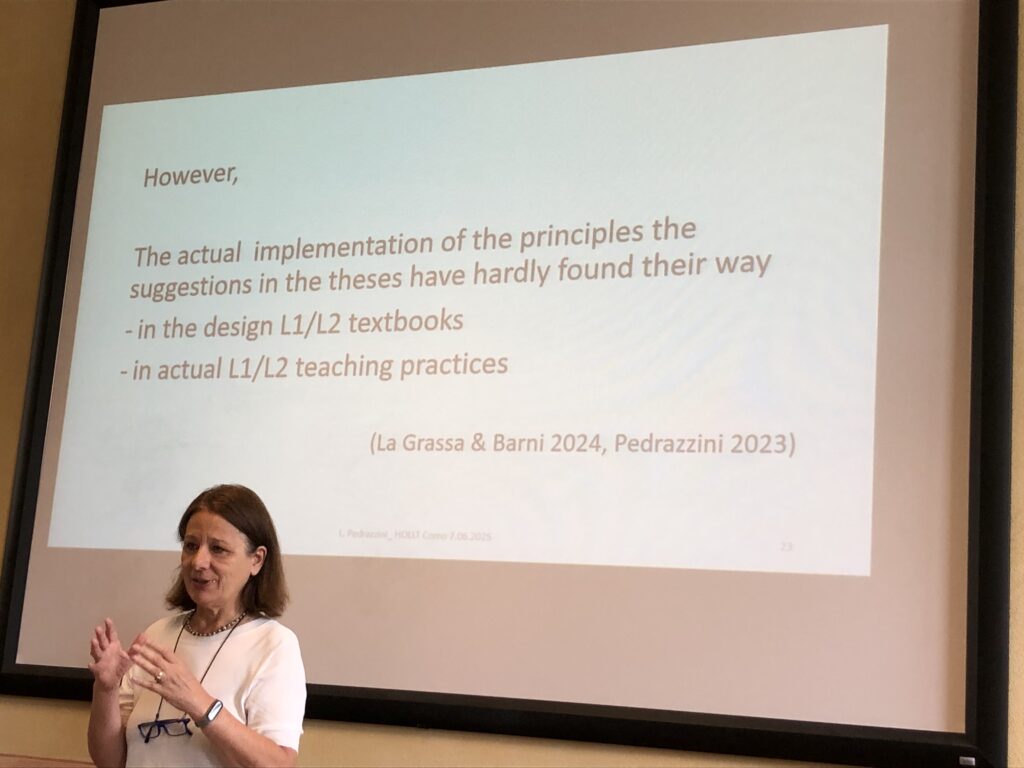
Luciana Pedrazzini and Emanuela Tenca participated presenting the findings of their research conducted in the context of the IELTA project. In her paper presentation titled “Educazione linguistica in the Italian school context: History and implementation in English language teaching materials (1970s-1990s)”, Luciana Pedrazzini explored the cultural and historical roots of the concept of educazione linguistica in Italy, and how this informed national school syllabuses and curriculum design for foreign language teaching since the end of the 1970s. Luciana Pedrazzini also presented examples of the way one of the principles of educazione linguistica, namely ‘reflection on language’, was first implemented in communicative-oriented English language teaching textbooks published in Italy in the 1980s and 1990s, and she finally discussed the opportunities of this approach in the light of recent and present-day proposals for plurilingual education.
Emanuela Tenca’s paper presentation was titled “Teaching English in Italian schools between 1900s and 1950s: Focus on pronunciation and spoken language”, and it presented the findings of a study conducted on a sample of 20 textbooks used in lower and upper secondary school, published between 1900s and 1950s, which are recorded in IELTA. Emanuela Tenca showed how the teaching of pronunciation and spoken English was gradually gaining in importance in the first half of the 20th century, although it was still mediated by Italian, with an emphasis placed on discrete structural elements of the language. It was only towards the end of the 1940s and the beginning of the 1950s that the textbooks began to integrate the teaching of pronunciation in a more principled manner (e.g. by systematically using IPA), thus showing the authors’ attempts to localise the latest methods for foreign language education to meet Italian learners’ needs. Emanuela Tenca also delivered a presentation during the pre-conference events, which illustrated the IELTA project.
ICHoLLT 2025 was organised under the auspices and with the support of the international network of associations and research centres within the field of the history of foreign language learning and teaching, which first convened in Granada in 2008: CIRSIL (Interuniversity Research Centre on the History of Language Teaching), Henry Sweet Society for the History of Linguistic Ideas, SEHL (Spanish Society for Linguistic Historiography), SIHFLES (International Society for the History of French as a Foreign or Second Language), and HoLLT.Net (AILA Research Network for the History of Language Learning and Teaching). Support was also granted by: ANILS APT (National Association of Foreign Language Teachers) and Lend (Language and New Didactics), Italian associations gathering teachers of foreign languages and Italian language; Phrasis (Italian Association of Phraseology & Paremiology), GISCEL Lombardia (Intervention and Study Group in the Field of Language Education), CRiFLi (Research Centre on Linguistic and Cultural Phenomena), AIA (Italian Association for the Study of English).